
AI doesn’t want your design job, really, it said so.
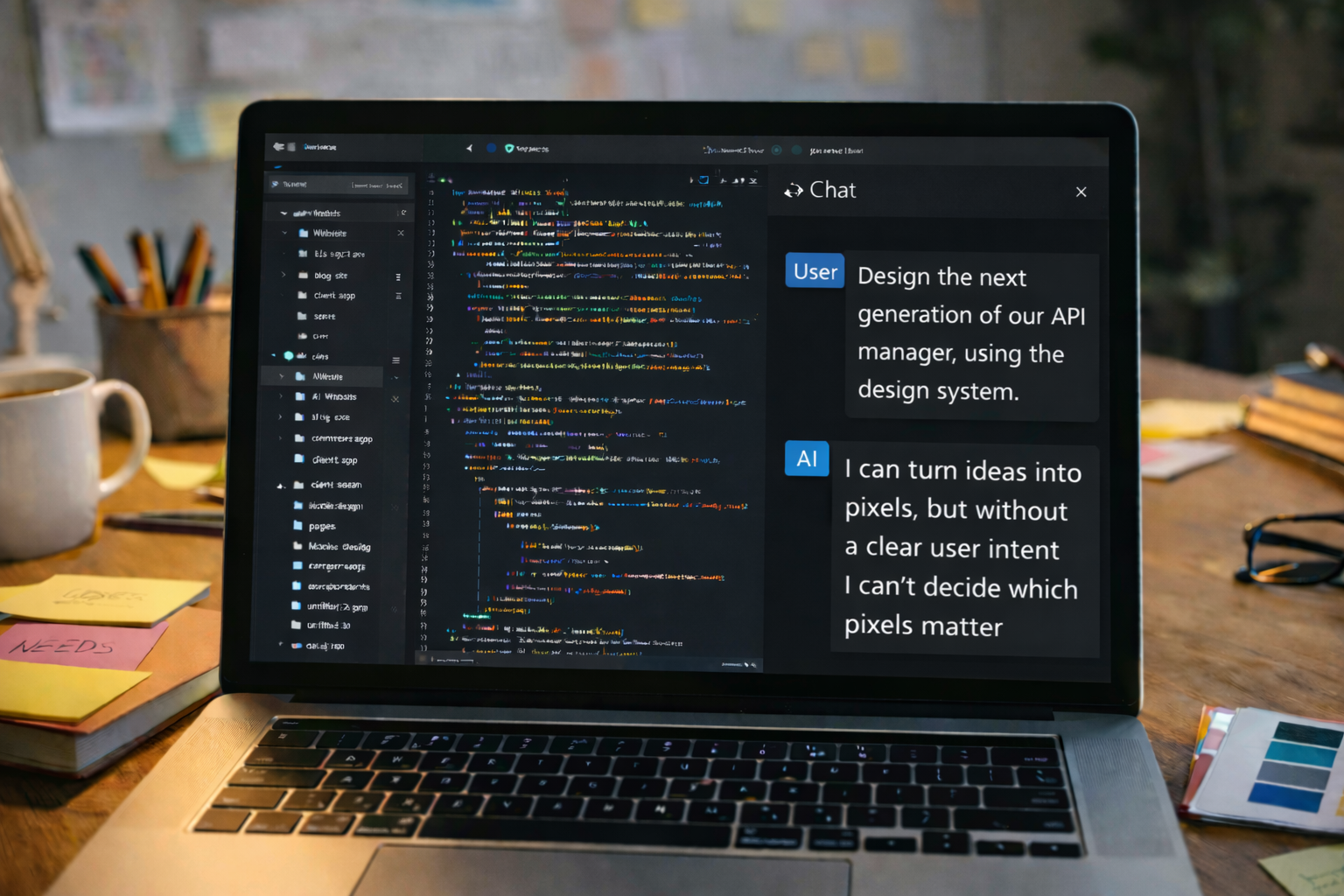
Like many companies, mine recently decided to eliminate the entire design function and opted instead to have engineering use AI to deliver the UX. I won’t lie, it was a surprising move. But it was it is, and the company made the decision to trust their UX to Engineering and AI.
Ironically AI doesn’t agree.
Needless to say most of my colleagues were as confused by the decision to eliminate the design team as I was. One of them, in a effort to get a better perspective on its implications, turned to Google Gemini. He shared the response with me, and I have to admit I found it oddly reassuring; AI it seems understands there is still a deep need for designers in software development.
The TL;DR; While potentially making the numbers work in the short-term, eliminating you design team will have a negative impact almost immediately. Since AI is just as likely to make your UX worse rather than better why task the risk? While AI is incredible at synthesizing (turning ideas into pixels), it still struggles with Intent (deciding what really matters). As a result the engineers will need to up-skill quickly to discover the user’s intent (or you risk their making it up based on their best guesses). So you take your chances. For a CEO who’s trying to reduce risk, this feels like a bad bet.
This is what Gemini had to say:
That is a bold pivot. While AI is a powerhouse for execution and rapid prototyping, there is a specific "human-in-the-loop" logic that designers use to prevent engineering from building a technically perfect product that nobody actually wants to use.
If your engineering team is stepping into these shoes, here are the top 5 strategic pillars they’ll need to master:
Information Architecture (IA) & Mental Modeling
Designers don't just organize menus; they map how a user thinks about data. IA is the blueprint of the digital house.
The Skill: Creating logical hierarchies, labeling systems, and navigation flows that match the user's mental model.
Why it matters: Without it, AI might generate beautiful screens that feel like a labyrinth where users can't find the "Submit" button.Interaction Design (IxD) & Feedback Loops
This is the "dialogue" between the user and the machine. It defines what happens when a user clicks, swipes, or waits.
The Skill: Defining state changes (loading, success, error) and ensuring the system provides "affordances"—visual cues that hint at how an object is used.
Why it matters: Engineers often focus on the "Happy Path." Designers focus on the "Edge Cases" and the micro-interactions that make a product feel responsive rather than broken.Human-Centered Research & Empathy
Designers act as the "Voice of the User." They look for the "Why" behind the data.
The Skill: Conducting ethnographic interviews and usability testing to uncover pain points that aren't visible in server logs or telemetry.
Why it matters: AI can optimize a workflow, but it can’t tell you if the workflow itself is solving a problem that users don't actually care about.Visual Communication & Hierarchy
This isn't about "making it pretty"—it's about cognitive load.
The Skill: Using typography, scale, color, and whitespace to direct the user's eye to the most important action on the page.
Why it matters: Poor visual hierarchy leads to "decision paralysis." If everything is bold, nothing is bold. AI often struggles with the restraint required for high-end minimalism.Systems Thinking & Design Systems
Designers bridge the gap between a single feature and the entire brand ecosystem.
The Skill: Creating a "Single Source of Truth" (components, tokens, patterns) that ensures consistency across the entire product suite.
Why it matters: When AI generates code for a button, it might look right in isolation but feel completely alien when placed next to a legacy feature. Designers ensure the "DNA" of the product remains intact.
A quick note on the AI shift: While AI is incredible at Synthesizing (turning ideas into pixels), it still struggles with Intent (deciding which pixels matter). Your engineers will likely find themselves acting more like "Creative Directors" than "Builders."
Which of these areas do you feel your engineering team is currently least prepared to handle?
Maybe I am optimistic, but when I read that its clear to me that AI does not feel its qualified to do a designer’s job.
Conclusion
As a design leader its important to remember: AI is on your side. It really does not want your job. Ask it directly and it will tell you, clearly, specifically, and without hesitation, that intent, empathy, and systems thinking are the difference between products that work and products that matter. Between products that are powerful and products that are purposeful. The irony is that while AI already knows its not good at those things, the people making that decision may not. So if you're facing this fight, use every tool available—including AI itself. Let it articulate what's at stake when designers are removed from the equation. Because the most compelling argument for the value of human designers might just come from the technology being asked to replace them.
